A library of learning games
Learn by doing, one short game at a time.
Push a toy car on ice, take a leaf cell apart, stack rock layers, and find out how things work.
Who's learning today?
Playing needs no account. No AI runs while you play.
What is here today
The number of games and subjects is counted from the game list each time the site is built.
Try one game right here.
Why did Rafi keep moving when the car stopped?
Push a toy car on ice and out in space, and a car on a road, to find out.

How a game teaches
Here is what a game asks you to do. Not every game has every step.
Pick a question to explore
Each game starts from a question you might ask yourself.
 Why did Rafi keep moving when the car stopped?Ages 11–16 · Physics
 Why does lettuce go limp?Ages 9–14 · Biology
 Is 0.05 bigger than 0.5?Ages 9–11 · Math
 Which rock is the oldest?Ages 9–10 · Earth science
 Who made it, and why?Ages 11–12 · Individuals and societies
 Was the wolf only hungry?Ages 11–12 · Language and literature
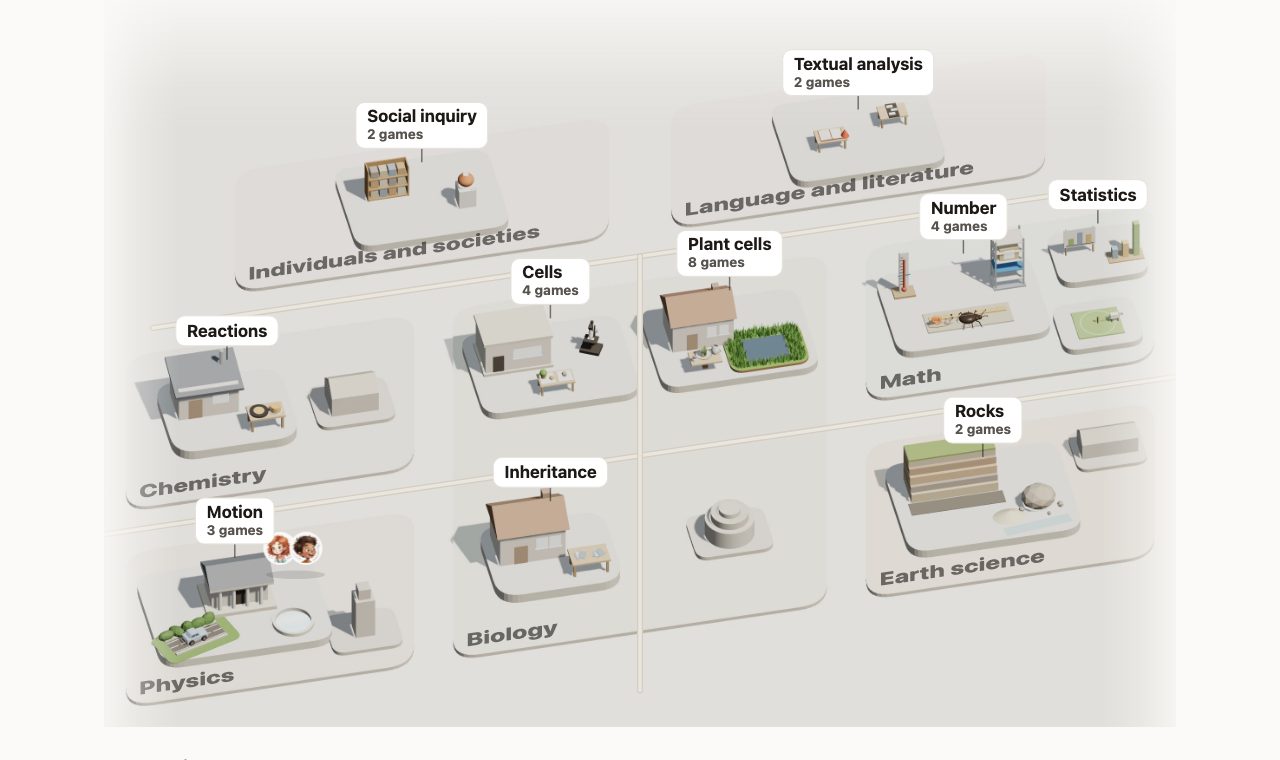
One map of everything you can learn
Each subject is a place on the map, and each place holds games.
Built on how people learn
The games use ideas from research on how people learn. Not every game uses all of them.
How each game is made
A person and an AI write each game ahead of time. Two separate AI checkers then read the sentences we list from each game, and a game goes on this site only when each fact they find has a source that a checker has read. No AI runs while you play.
Found a mistake? Write to us at emily@keylink.io.
For parents
- Play together, and see what your child learned in the games that keep a record, one child at a time.
- Print the games that have a paper version and try them at the kitchen table.
- Your child's name stays in this browser. A survey you choose to send carries your answers and how far a game got. It asks for no name.
For teachers
- Show a game on the board, or let each student play on their own device.
- Print the paper version of a game for class.
- No accounts and no class setup.